Dependency-Injection
Overview
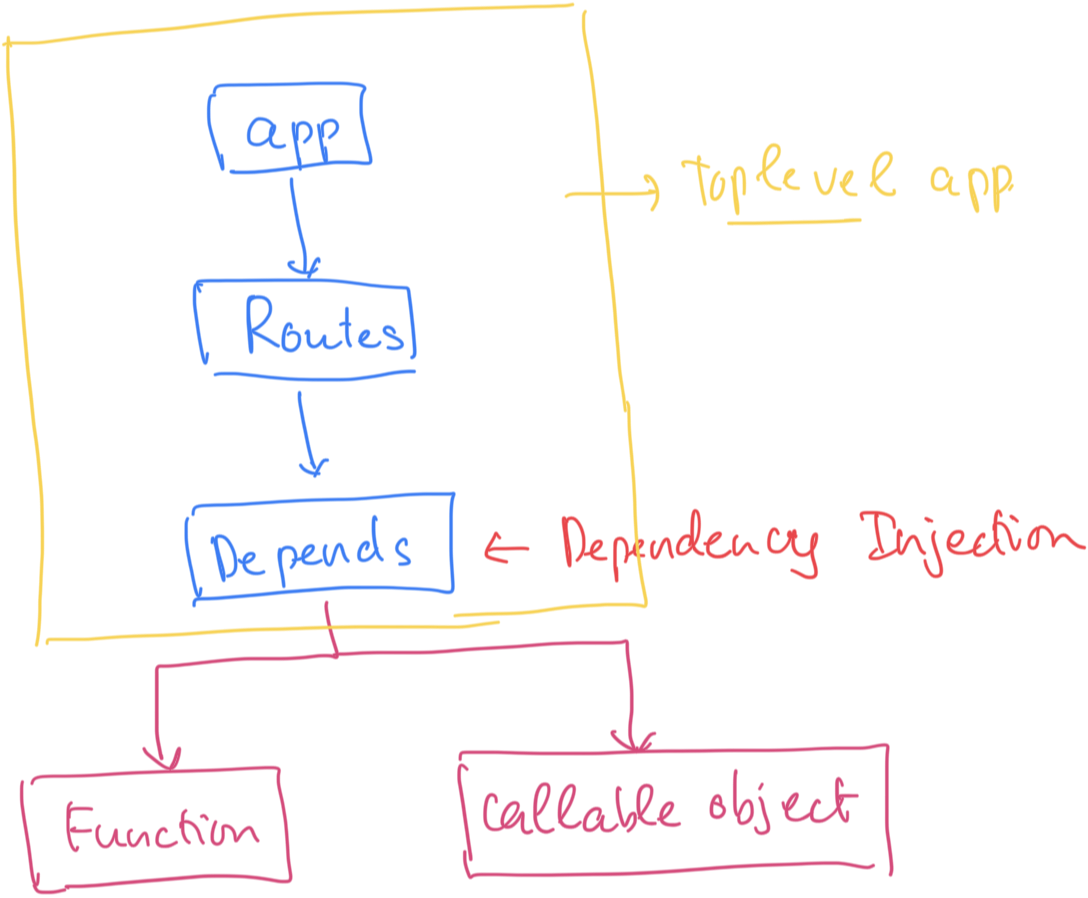
What Depends does
n FastAPI, Depends is a dependency injection system. It lets you declare that your endpoint (or another dependency) depends on a certain function — and FastAPI will automatically call that function, handle its logic, and pass the returned object to where it’s needed.
from fastapi import FastAPI, Depends

app = FastAPI()

# A dependency function
def get_database_connection():
    db = {"connection": "Connected to DB"}  # pretend this is a DB connection
    try:
        yield db   # yield allows cleanup later
    finally:
        db["connection"] = "Closed"

# An endpoint that depends on that object
@app.get("/items/")
def read_items(db=Depends(get_database_connection)):
    return {"db_status": db["connection"]}
What happens:
FastAPI sees db=Depends(get_database_connection).
It calls get_database_connection().
It injects the returned object (db) into your endpoint function.
It handles cleanup if you used yield.
Why it’s powerful
You can use dependencies to:
- Open/close database connections
- Verify authentication
- Parse headers or tokens
- Reuse logic across multiple routes Dependencies can depend on other dependencies — forming a tree of logic.
What happens under the hood
- Step 1: FastAPI inspects the route handler’s signature When you write:
def read_items(db=Depends(get_database_connection)):
FastAPI doesn’t immediately call get_get_database_connectiondb().
Instead, it records that db depends on get_get_database_connectiondb.
It internally builds a dependency graph (a tree of all dependencies).
- Step 2: At request time When a request hits /users:
FastAPI checks the route’s declared dependencies. For each parameter that is Depends(some_func):
- It calls that function (some_func()), resolving its own dependencies recursively.
- It
awaitsit if it’sasync. - It injects the return value into the route function as the parameter.
So this:
db=Depends(get_database_connection)
is not a normal Python function call like db = get_database_connection() — it’s a declarative marker telling FastAPI:
“When handling a request, please call get_database_connection() first, and pass its result here.”
- Step 3: Dependency context management
If your dependency uses
yield, like:
def get_database_connection():
    db = {"connection": "Connected to DB"}  # pretend this is a DB connection
    try:
        yield db   # yield allows cleanup later
    finally:
        db["connection"] = "Closed"
then FastAPI:
- Calls it as a context manager
- Keeps track of cleanup (
finally) after the response is sent - It handles this using Starlette’s
request.state+asynccontext stack internally.
# Introspect dependency graph
for route in app.routes:
    if hasattr(route, "dependant"):
        print(f"\nRoute: {route.path}")
        dependant = route.dependant
        print("Top-level dependency:", dependant.call)
        for sub in dependant.dependencies:
            print(" ├─ depends on:", sub.call)
            for sub2 in sub.dependencies:
                print(" │   └─ depends on:", sub2.call)